Japanese woodblock prints began being produced during the Edo period (1603 – 1867). “To create a woodblock print in the traditional Japanese style, an artist would first draw an image onto washi, a thin yet durable type of paper. The washi would then be glued to a block of wood, and—using the drawing’s outlines as a guide—the artist would carve the image into its surface. The artist would then apply ink to the relief. A piece of paper would be placed on top of it, and a flat tool called a baren would help transfer the ink to the paper. To incorporate multiple colors into the same work, artists would simply repeat the entire process, creating separate woodblocks and painting each with a different pigment.” (Shovava)
Suzuki Harunobu (1725-1770)
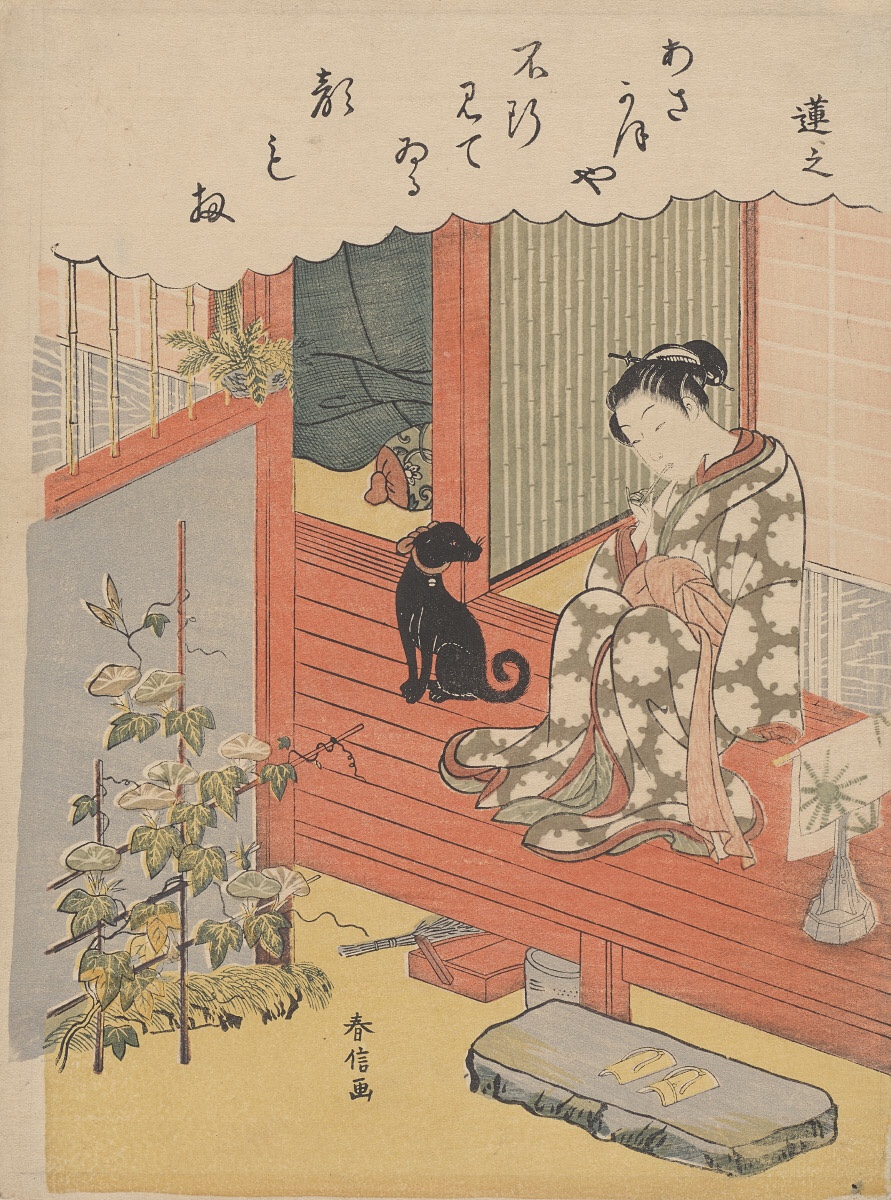
“Renshi” was created in 1768 by Suzuki Harunobu. This print, along with others from his collection, are now located in the Portland Art Museum. Harunobu was known for his typical China and Japan everyday life scenes. He had also dominated the field of full color prints. This technique uses 5 or more woodblocks for each impression and the final print was called “brocade pictures.”
I like the different patterns throughout this print. On the wall behind the woman, there is a block pattern and a striped pattern, which looks like bamboo. There is also a pattern on the woman’s robe, it looks like leaves or some sort of suns. I also love how detailed this print is, especially the plant right outside the door. The plant’s leaves look very realistic. It’s amazing to think this print was made from being carved into a wood block, then pressed perfectly to have ink transferred.
Utamaro (1753-1806)
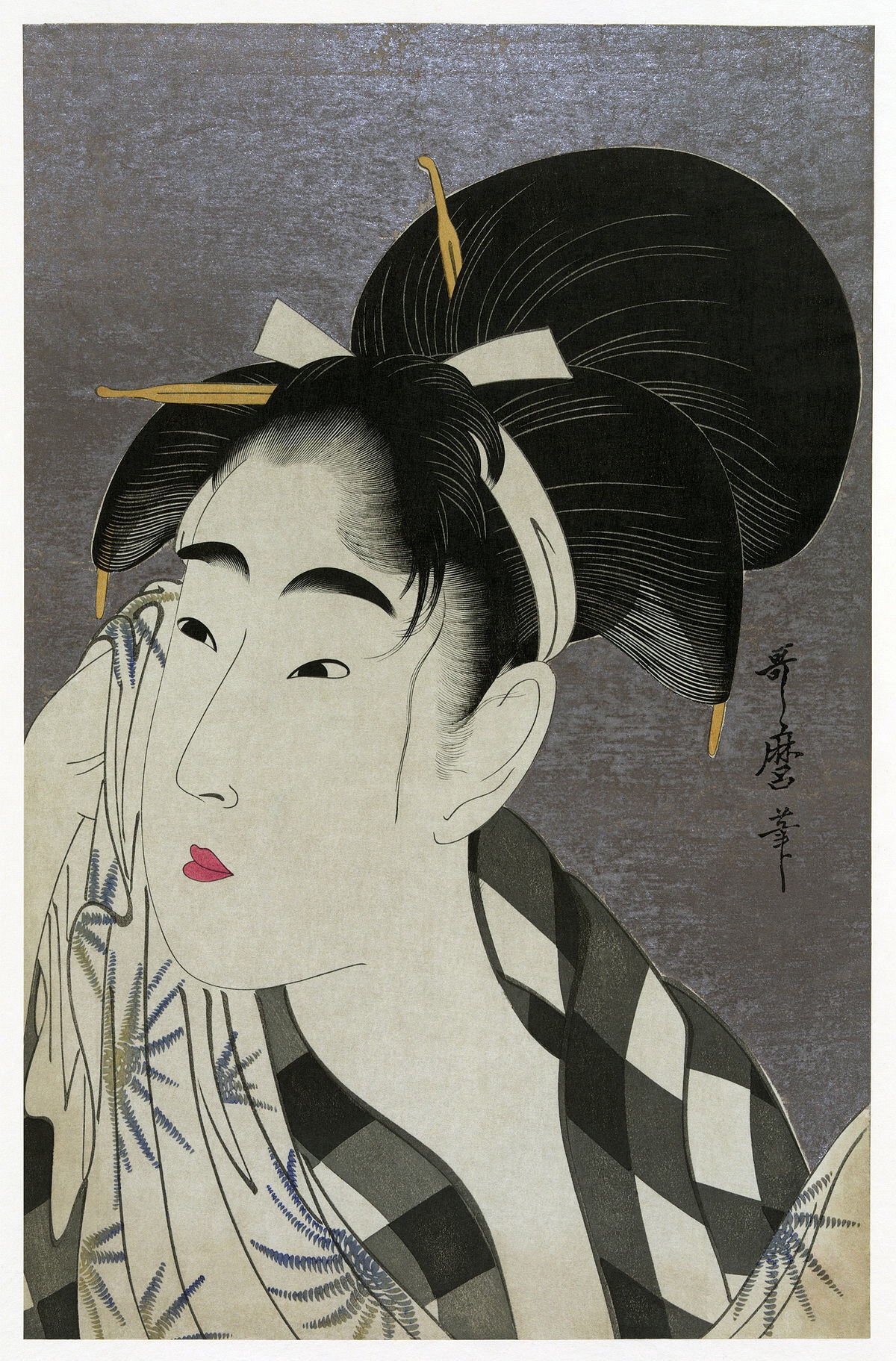
“Woman Wiping Sweat” was painted in 1798 by Utamaro. Utamaro is best know for his “large-headed pictures of beautiful women” of the 1790s.
I love the patterns throughout this print. The plaid on her shirt or shall contrasts well with the sun pattern of her shall. I love the sun pattern especially because of the movement from yellow in the middle to blue on the tips. The woman’s face doesn’t quite look 3D, it looks quite flat. I love the details to her hair, it really looks like individual strands. The bold red color of her lips contrast really well to her face, making the color pop from the print.
Katsushika Hokusai (1760-1849)
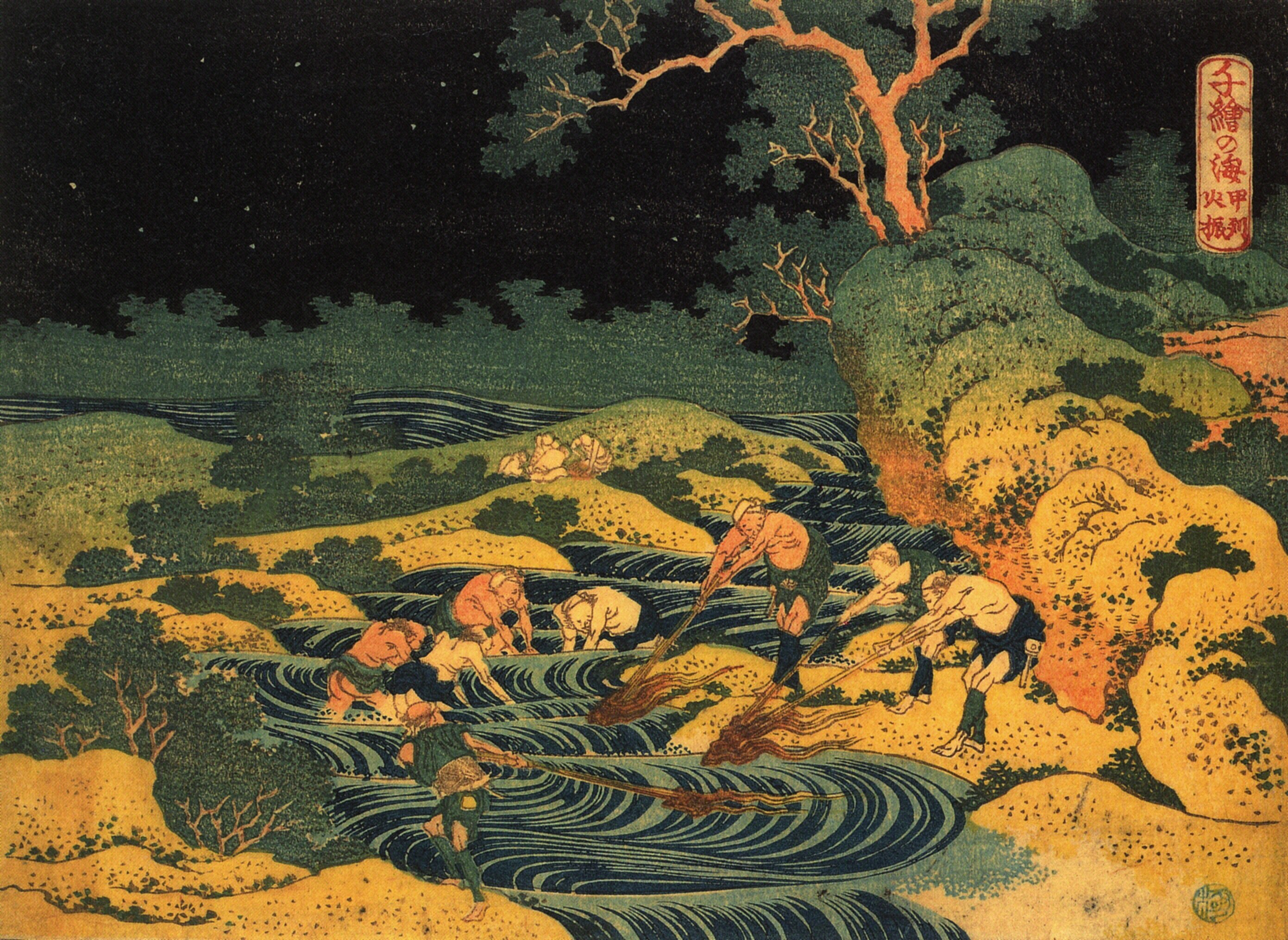
“Fishing by Torchlight in Kai Province” was created by Hokusai in 1833. The print is located at the Museum of Fine Arts in Boston. Hokusai is best known for “The Great Wave Of Kanagawa.”
I love the moment from color to color in this print, going from light to dark, bottom to top. The spotted patterns of the tree and ground really add contrast to the colors. The different lines throughout the print give it a sense of rolling hills and rolling waves. The patterns of the water give it a sense of fast moving water. There’s even little splashes around the worker’s feet. It’s amazing how detailed someone could carve to create a print like this.
Hiroshige (1797-1858)
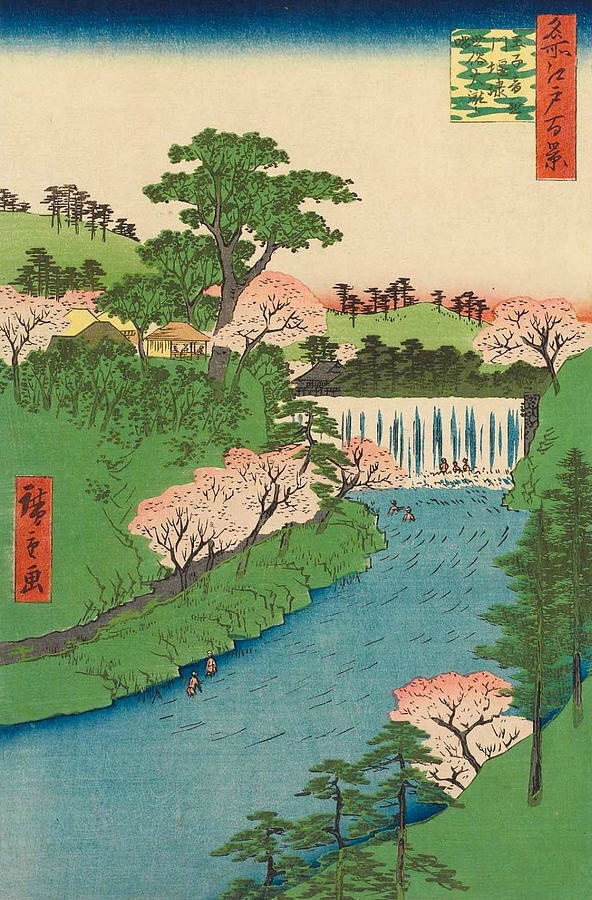
“Dam on the Otonashi River in Oji” was created by Hiroshige in 1857. The print also has the nickname “The Great Waterfall.” The painting depicts a popular park covered with cherry blossoms and other trees.
I love the pink colors throughout the print. The fading light pink to darker in the trees is very beautiful, I love cherry blossom trees. The different shades of blue in the river give it a sense of depth or shade of something overhead. I also love the texture of the waterfall, it gives a crashing effect towards the bottom. The whole mood of the print is kind of calm and tranquil. It reminds me of a quiet scene where I would love to visit. This is my favorite print out of the ones I have talked about.
Works Cited
“Hokusai.” Artnet, http://www.artnet.com/artists/katsushika-hokusai/
Shovava. “The Unique History and Exquisite Aesthetic of Japan’s Ethereal Woodblock Prints.” My Modern Met, 2 Aug. 2019, https://mymodernmet.com/ukiyo-e-japanese-woodblock-prints/
“Suzuki Harunobu and the Culture of Color.” Portland Art Museum, https://portlandartmuseum.org/exhibitions/suzuki-harunobu/
The Editors of Encyclopaedia Britannica. “Utamaro.” Encyclopædia Britannica, Encyclopædia Britannica, Inc., 27 Oct. 2019, https://www.britannica.com/biography/Utamaro
“Tokyo’s Great Waterfall: ‘Dam on the Otonashi River in Ōji.’” Nippon.com, 6 Mar. 2019, https://www.nippon.com/en/guide-to-japan/gu004003/tokyo’s-great-waterfall-dam-on-the-otonashi-river-in-oji.html






 Lane's blog